
The Pollution Control Department (PCD), Ministry of Natural Resources and Environment in Thailand, is drafting a Sustainable Packaging Management Act, emphasising EPR. While the effort for the legislation of EPR is ongoing, there are opportunities to raise awareness and enhance the capacity of key stakeholders, including the government and the private sector. The UN Environment Programme (UNEP)’s project, funded by the UN Peace and Development Trust Fund (UNPDF) 2030 Agenda Sub-Fund, aims to enhance the capacity of the government and businesses in Thailand to develop and implement EPR. The UNPDF project is collaborating closely with the COBSEA Secretariat and GIZ Thailand to complement the activities of the MA-RE-DESIGN project, bringing in regional perspectives. It will contribute to the ‘Plan 6: create awareness and build cooperation with relevant stakeholders/public sector’ of the 5-year EPR Implementation Plan (2023-2027) of the Draft Sustainable Packaging Management Act. This workshop is the first activity of this project. It aims to facilitate policy development in Thailand by learning from other countries’ experiences in EPR legislation. It will also contribute to the second activity of the project, in which the EPR training materials will be developed into an online module to enable wider dissemination and longer shelf life of the contents.
Project Coordinator:
Dr.Panate Manomaivibool, Assistant Dean for Academic Services and Sustainable Management, International College
Objectives:
- To understand the current situation of plastic circularity in the region, especially the state of solid waste management and plastic pollution.
- To update on the policies related to plastic circularity, focusing on developing the Draft Sustainable Packaging Management Act and voluntary EPR actions.
- To define the stakeholders and their capacity-building needs to enable them to follow the roadmap better.
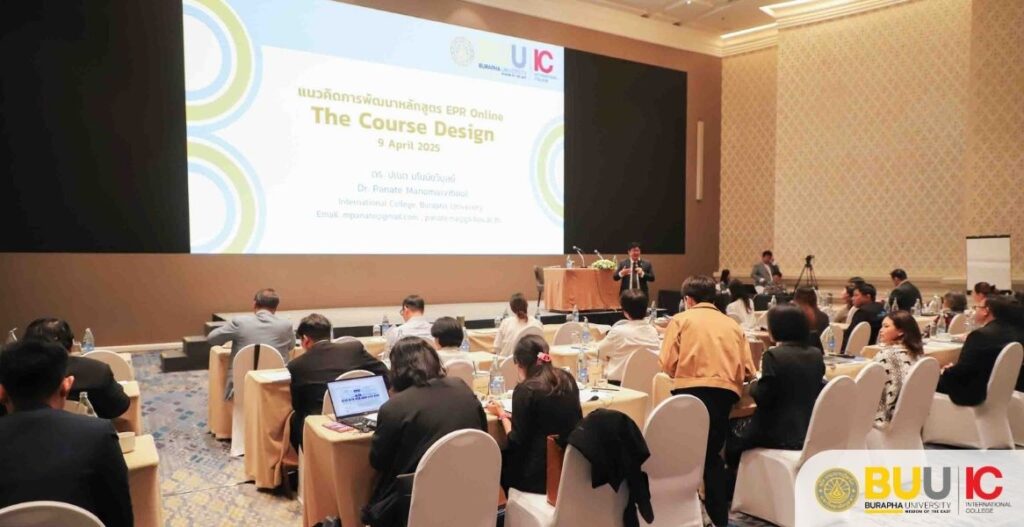
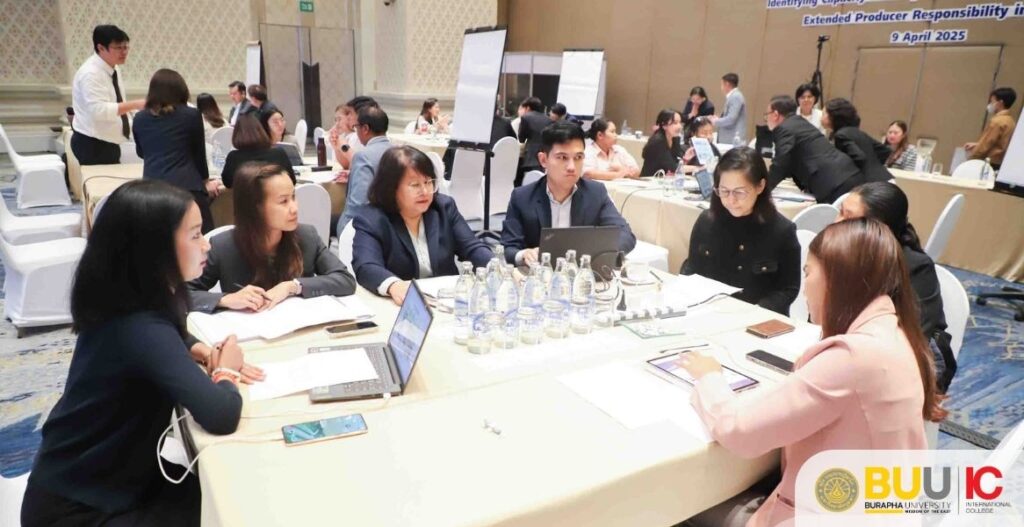
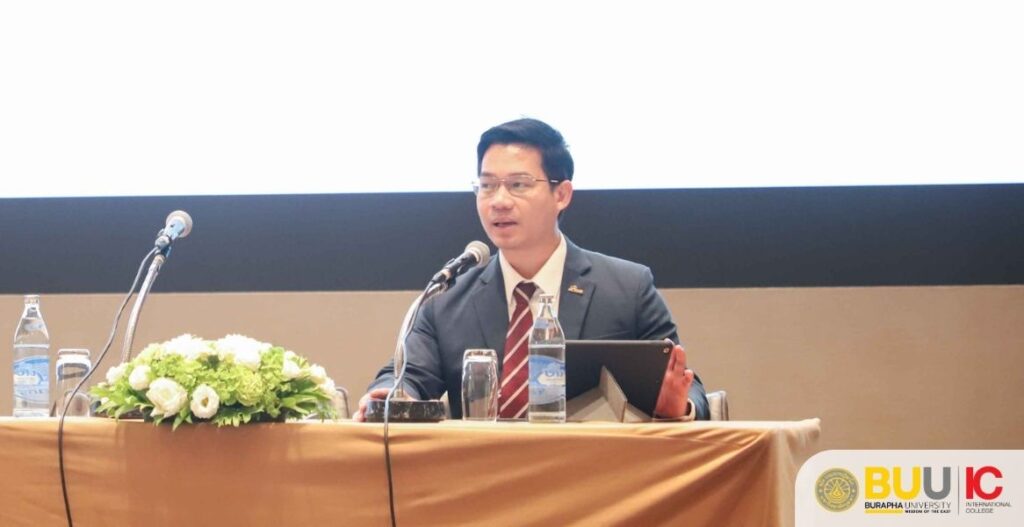
Dr. Panate Manomaivibool of BUUIC presented the framework for the EPR Online Course. The course is built around three key learning objectives: • Understanding EPR Principles: Explaining the concept, its goals, and its alignment with broader sustainability and waste management policies. • Roles & Responsibilities: Defining the distinct roles of producers, supply chain actors, government agencies, and consumers in effectively implementing EPR. • Implementation Strategies: Exploring best practices for designing and managing EPR programs, including take-back schemes, eco-design, and material recovery. The participants were divided into smaller groups to foster engagement and stimulate brainstorming. Five groups, each comprising 6–8 individuals, were randomly formed to ensure diversity in backgrounds.
The consultation began with individual assessments, followed by collaborative brainstorming, group discussions, and sharing sessions. Each participant was provided with a printed set of instructions for the activity. An online application was an interactive tool to facilitate participation and record inputs effectively. Participants were asked to identify the sector they belonged to and assess their level of knowledge about EPR using a 1–5 scale, where 5 represented an excellent understanding of EPR and 1 indicated minimal understanding. Participants were then tasked with evaluating two aspects of each chapter in the existing EPR online course outline: the chapters’ significance and key contents. Responses were recorded using the 1–5 scale, where five represented “very good” and one represented “very poor.” On average, the significance of all chapters received high scores exceeding 4.20, reflecting strong approval.
However, the content evaluation was less satisfactory, with two chapters receiving scores below 4.00, indicating areas for improvement. During the second round of activities, the focus shifted to fostering group discussion. Each group was allotted 5 minutes for brainstorming and 3 minutes to submit their collective answers via Kahoot. Responses were shared with the entire room, and the moderator facilitated discussions. The final brainstorming session mirrored the second round but allowed groups 7 minutes to propose ideas for the online course.
Expected Outcomes (Impacts):
The feedback from the consultation workshop is used to revise the course structure. The revised design covers the following seven modules after the course introduction:
1. Reframing the waste problem in the circular economy context,
2. Why EPR? The Rationale and Policy Goals
3. How Producer Responsibility Works: Models & Mechanisms
4. Mapping Roles & Responsibilities in the Value Chain
5. The Engine of EPR: Understanding Producer Responsibility Organisations
6. Global Insights: The EPR Policy Landscape
7. Thailand’s Path Forward: Legal Developments & Future Directions.
BUUIC Hosts Stakeholder Consultation Workshop on Plastic Circularity and EPR.On April 9, 2025, the International College, Burapha University (BUUIC), in collaboration with the United Nations Environment Programme (UNEP) and the Coordinating Body on the Seas of East Asia (COBSEA), organised a stakeholder consultation workshop at Pullman King Power Bangkok. More than 40 participants from government agencies, the private sector, trade associations, environmental NGOs, and academic institutions had joined the workshop to discuss capacity-building priorities related to plastic circularity and extended producer responsibility (EPR). Attendees received key national and regional circular economy policy updates and participated in productive discussions to identify sustainable and scalable solutions. The event also introduced the framework of BUUIC’s upcoming online course on EPR, which will be delivered in Thai and English. Stakeholders provided valuable feedback on the course’s structure and content, helping to ensure it aligns with real-world needs. This workshop forms part of UNEP’s broader initiative to strengthen Thailand’s capacity to address plastic pollution. The online course, a central component of this project, is expected to launch in September 2025 and will serve as a foundational tool to enhance stakeholders’ understanding and implementation of EPR principles nationwide.
Date of Implementation: April 9, 2025