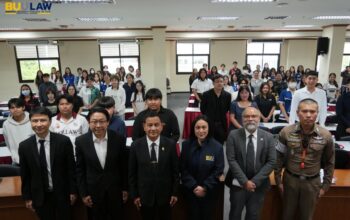

The Department of Law, Faculty of Political Science and Law, Burapha University, recognises the importance of enhancing students’ capacity in accordance with Outcome-Based Education (OBE) and AUN-QA Version 4. First-year Bachelor of Laws students face significant challenges in adapting to legal studies, particularly in legal reading, analysis, reasoning, and structured law examination writing. Quality assurance processes and stakeholder feedback indicate that many students lack adequate understanding of legal reasoning and appropriate answer-writing techniques. This project, therefore, aims to strengthen foundational competencies in legal reasoning, academic communication, and systematic examination writing in law, which are essential to achieving the Program and Course Learning Outcomes. The project also supports Sustainable Development Goals, particularly SDG 4 (Quality Education) and SDG 16 (Peace, Justice and Strong Institutions), by developing competent and ethical future legal professionals. In addition, the project serves as a mechanism for student progression support and continuous quality improvement in teaching and learning under the AUN-QA framework, ensuring sustainable academic and professional development.
Project Coordinator: Dr.Paradee Plumkoson
Objectives:
- To enhance students’ knowledge, understanding, and techniques in law examination writing, including systematic and accurate legal reasoning, as key competencies supporting the expected learning outcomes of the Bachelor of Laws program and future legal practice.
- To strengthen students’ ability to continuously practice, develop, and apply law examination writing and legal reasoning skills sustainably, in accordance with the concept of lifelong learning and the Sustainable Development Goals.
- To monitor, evaluate, and support students’ academic progression and professional competencies during their studies, in line with the Student Progression and Support approach under the AUN-QA Version 4 quality assurance framework.
- To promote collaborative learning and knowledge exchange between students and faculty members in the Department of Law, contributing to the continuous improvement of teaching quality and curriculum development.
Program Activities:
The project provided lectures and instruction on techniques for writing law examination answers, with an emphasis on structuring answers, citing relevant legal provisions, and applying accurate, comprehensive legal reasoning. This approach enabled students to effectively apply the knowledge and skills acquired to their studies, examinations, and academic assessments. Throughout the project, students had opportunities to ask questions, exchange ideas, and engage in collaborative learning with the speakers.
Expected Outcomes (Impacts):
- Students have enhanced their knowledge and skills in law examination writing and systematic legal reasoning, in alignment with the expected learning outcomes of the Bachelor of Laws program. 2. Students can continuously and sustainably practice, develop, and apply the knowledge and techniques acquired to their studies and preparation for future legal professions. 3. The curriculum and the Department of Law can monitor and assess students’ academic progression and potential during their studies, using this information to support continuous improvement in teaching and curriculum development. 4. Students, faculty members, and external experts have engaged in collaborative learning and knowledge exchange, contributing to the enhancement of academic understanding and professional competencies in the field of law.
Date of Implementation: March 1, 2026