
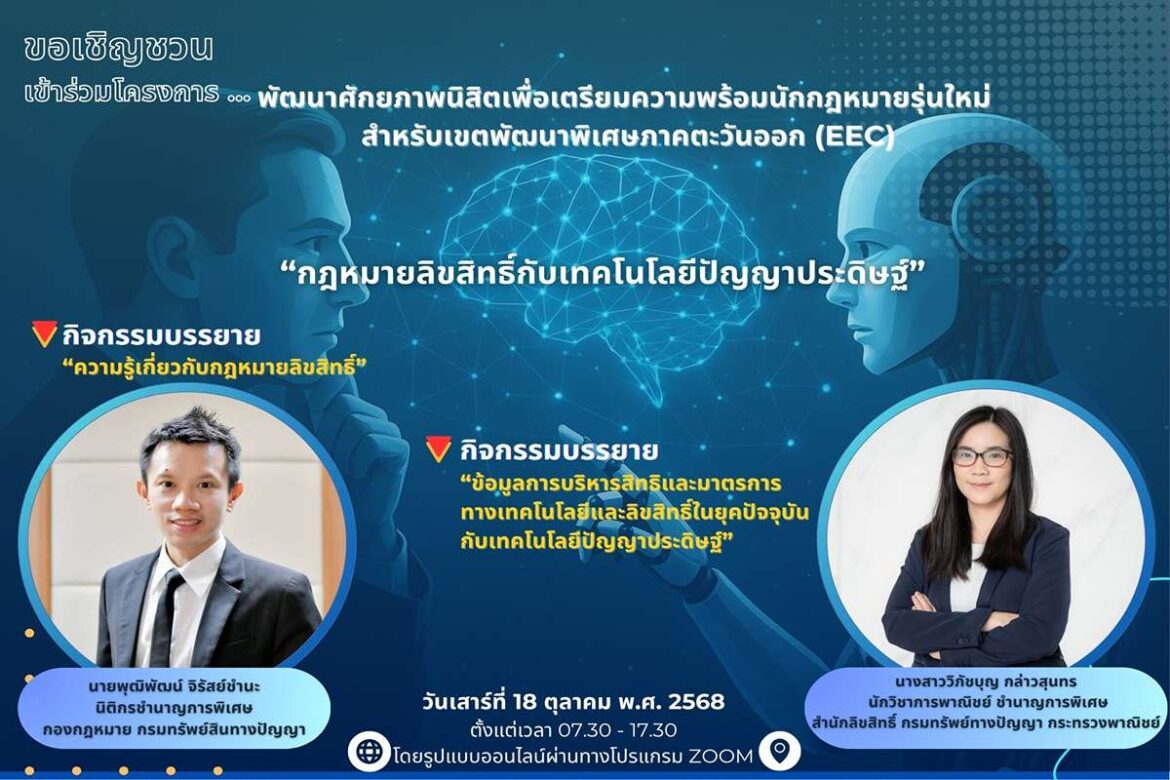
Intellectual Property Law serves as a crucial instrument for balancing the protection of creators’ works with the promotion of innovation within society. Today, Artificial Intelligence (AI) has become a powerful creative tool, yet its use introduces significant legal debates concerning IP protection, authorship, ownership, and ethical compliance in the digital economy. The Eastern Economic Corridor (EEC) is designated as a leading economic zone, emphasising digital technology and AI as drivers of national innovation. The rapid expansion of AI applications in manufacturing, services, and healthcare inevitably generates new legal challenges, particularly regarding AI-generated works. Therefore, legal expertise at the intersection of Intellectual Property Law and AI is an essential competency for future lawyers. To meet this emerging demand, the Department of Law initiated this project to upskill students studying Intellectual Property, preparing a generation of legal professionals capable of addressing complex issues in the EEC and the broader digital world, in alignment with SDG 4, SDG 9, and SDG 16.
Project Coordinator: Mr. Tanapat Lekkiatkhaсhorn
Objectives:
- To ensure students acquire a fundamental grasp of Intellectual Property Law and its application to Artificial Intelligence (AI) technology, specifically addressing copyright protection, legal challenges, and current case studies related to AI-generated works.
- To empower students to effectively translate this knowledge into their academic pursuits and future professional careers, particularly within the fast-evolving legal landscape of the EEC.
- To establish a platform for knowledge exchange between students and external experts, thereby integrating theoretical legal studies with practical industry insights on AI and Intellectual Property issues.
Program Activities:
The project was delivered through a live, interactive academic lecture on Zoom. Activities featured expert presentations on critical legal principles and facilitated structured discussions among participants. This real-time delivery methodology ensured direct, effective knowledge exchange, optimising the interactive learning process and supporting the project’s upskilling objectives for future legal professionals.
Expected Outcomes (Impacts):
- The project enhanced students’ knowledge and understanding of Intellectual Property Law, enabling them to apply such legal principles effectively in related coursework and in their future professional practice.
- The project strengthened the competencies of law students through academic exchange and experiential learning gained from the expertise of the invited special lecturer.
Date of Implementation: Oct 18, 2025