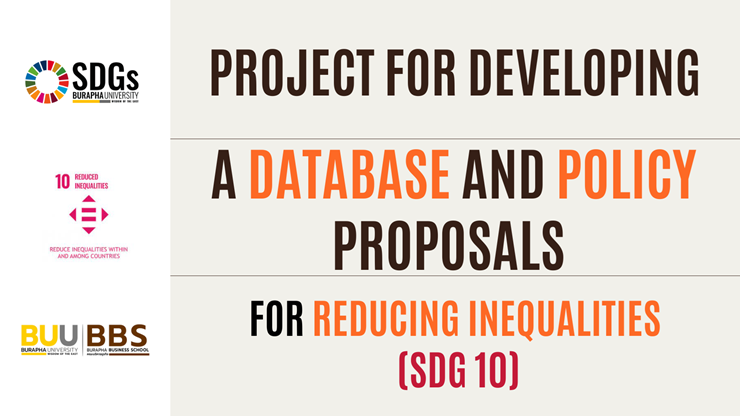
Burapha University (BUU), in its role as a “University for Society,” has proactively driven Sustainable Development Goal (SDG) 10 on Reduced Inequalities. The Burapha Business School (BBS) spearheaded the effort, collaborating with the Faculty of Music and Performing Arts and the Faculty of Humanities and Social Sciences to implement the “Project for Developing a Database and Policy Proposals for Reducing Inequalities (SDG 10).”
Project Coordinator: Assistant Professor Dr.Wanvicechanee Tanoamchard, Miss Wannapa U-dompon, Dr.Sanon Anantanond, Dr. Kamolwan Rodhring, Burapha Business School
Objectives:
- To develop an evidence-based database that supports the collection and analysis of data related to equality and inclusion.
- To promote participation of students and staff from vulnerable or underrepresented groups in academic and social initiatives.
- To formulate policy recommendations that lead to tangible actions in reducing social and institutional inequalities.
- The project serves as a key mechanism reflecting the Burapha Business School’s commitment to integrating the university’s role with social missions, fostering equity and sustainability at the institutional level.
Program Activities:
Data were systematically collected from students across all faculties of Burapha University, spanning three campuses (Bangsaen, Chanthaburi, and Sakaeo). The data collection process employed a questionnaire survey as the primary research instrument, designed to gather information on students’ socio-economic backgrounds, educational experiences, and perceptions of equality and inclusion within the university environment.
The questionnaire was distributed electronically to faculty coordinators or assigned representatives responsible for student affairs in each faculty. These coordinators played a crucial role in facilitating communication and ensuring that the questionnaires reached students across all academic years, from first-year to final-year undergraduates. The use of this distribution method helped enhance participation rates and ensured that the data reflected the diverse characteristics of the student population across disciplines and campuses.
The data collection phase emphasised confidentiality and voluntary participation, aligning with ethical standards for academic research. Participants were informed of the study’s purpose and assured that their responses would be used solely for research and policy development. The analysis aimed to identify inequalities, barriers, and opportunities that exist within the university community, particularly among vulnerable or underrepresented groups. The overall findings were then used to support evidence-based recommendations for policy development, ensuring that Burapha University continues to promote inclusiveness, equality, and sustainability in higher education.
Expected Outcomes (Impacts):
Key Findings from a Survey of 1,180 Students:
- Educational Opportunity (First-Generation): The survey revealed that students who are the “first person in their family to have the opportunity to study at the university level” (First-Generation Students) accounted for a high proportion of 62.97%. This significantly reflects the university’s crucial role in opening the door to higher education for households that previously lacked access.
- Economic Vulnerability: Although families remain the primary source of funding, around one-third of students’ financial situations depend on student loans (e.g., SLF – Student Loan Fund), income from work, or other grants/scholarships. This highlights the necessity for proactive financial assistance mechanisms.
- Students with Disabilities: The proportion of students officially registered as having a disability (based on disability card criteria) was only 0.25%. This figure is extremely low and potentially understated, underscoring the need to implement “Reasonable Accommodation” measures alongside robust personal data protection and synthesising Student Voices into Six Urgent Policy Packages.
The project gathered 28 suggestions from student feedback. It synthesised them into Six Urgent Policy Packages to transform structural problems into concrete operational measures, as follows:
- Educational Opportunity and Scholarships: Increase diverse scholarship types, such as emergency funds and equipment grants, along with establishing a “Scholarship Advisory Center” and developing an on-campus Work-Study program.
- Cost of Living and Financial Burden: Establish a system for instalment payments for tuition/dormitory fees and create a “Student Financial Services Unit” to coordinate with the Student Loan Fund (SLF) and reduce delays in disbursement processes.
- Access to Learning Resources: Organise a “Learning Equipment Loan” program (laptops/tablets) and upgrade libraries/computer rooms for flexible opening hours, while also increasing high-speed Wi-Fi access points.
- Fairness in Teaching and Learning: Elevate policies on “Impartial Grading” and organise training for staff/students on “Diversity and Coexistence” to prevent bullying and stigmatisation.
- Communication and Language: All essential information across all channels should be in “Thai–English,” and scholarship/activity information should be centralised on a single, easy-to-search website.
- Facilities and Public Services: Increase the frequency/adjust the routes of the shuttle bus service to be more appropriate, and improve roads/walkways/accessibility for wheelchair users based on actual needs. This project goes beyond merely creating a database; it marks the beginning of a “Cycle of Continuous Improvement” that will genuinely lead to structural reduction of inequalities and create sustainable social impact for Burapha University.
Date of Implementation: June – October 2025