Rapid advancements in Artificial Intelligence (AI) present transformative challenges and opportunities for copyright legal frameworks worldwide. As a flagship academic institution in the Eastern Economic Corridor (EEC), Burapha University’s Faculty of Law recognises the critical need to equip future legal professionals with modern legal literacy and strategic competence. Bridging academic theory with national practice is essential for strengthening regulatory mechanisms, intellectual property governance, and institutional efficiency. By inviting experts from the Department of Intellectual Property, this project equips law students to navigate complex digital disruptions, directly supporting rule-of-law readiness, sustainable economic growth, and transparent governance in line with SDG 16 standards.
Project Coordinator: Mr. Tanapat Lekkiatkhachorn


Objectives:
1.To enhance law students’ knowledge and critical understanding of copyright issues arising from Artificial Intelligence technologies.
2.To build student capacity and professional readiness for emerging legal shifts within the Eastern Economic Corridor (EEC).
3. To bridge theoretical legal education with real-world practice through public sector expertise and cross-institutional academic exchange.

Program Activities:
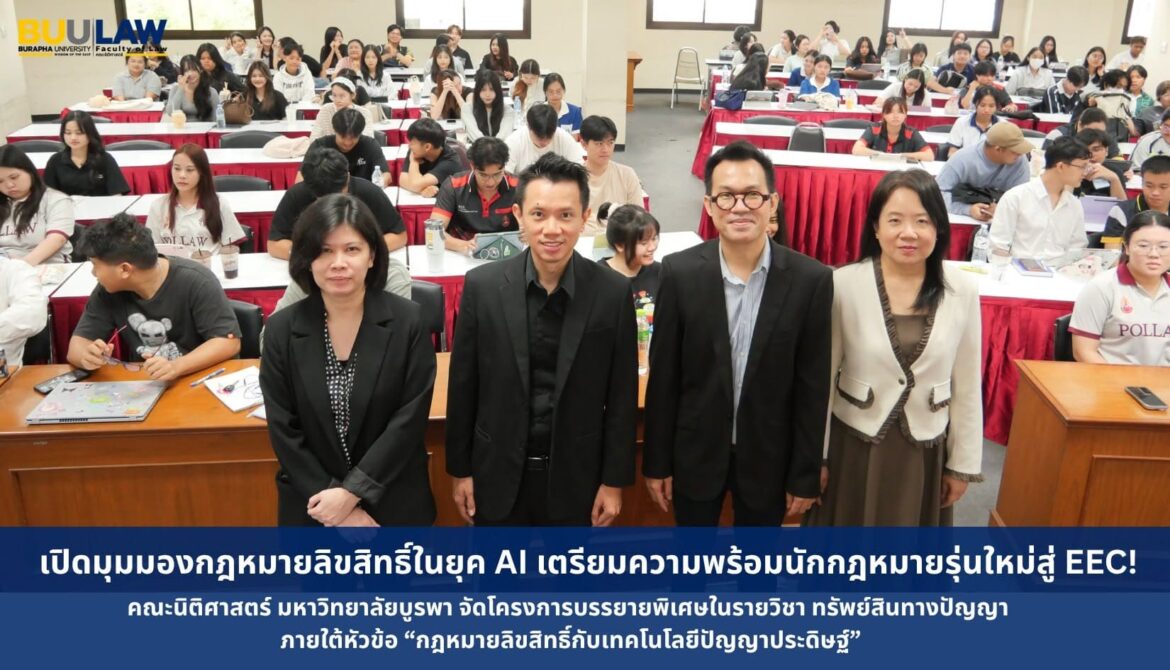
The project convened a special lecture embedded in the Intellectual Property Law course at Rooms LAW 603 and LAW 501, Faculty of Law, Burapha University. Keynote speaker Mr Putthipat Jiratchamna, Senior Legal Officer from the Legal Division of the Department of Intellectual Property, delivered an expert presentation on copyright doctrines, AI-generated works, evolving jurisprudence, and legal challenges in the digital era. The session included interactive discussion and Q&A segments where students analysed practical case studies alongside government policy perspectives.
Expected Outcomes (Impacts):
- Enhanced Academic Upskilling: Advanced law students’ specialised expertise in AI-driven intellectual property challenges, bridging the gap between classroom theory and real-world application.
- Strengthened Public-Academic Collaboration: Fostered active partnerships between Burapha University and the Department of Intellectual Property, establishing an institutional model for policy-oriented legal education. 3.EEC Regional Capacity Building: Prepared a new generation of legally agile graduates equipped to support transparent legal frameworks and technological innovation in the Eastern Economic Corridor.
Date of Implementation: October 18, 2026